

There are three criteria a lender looks for when deciding how much and whether to approve your home loan application.
By understanding these, you can plan ahead so that when you apply for a loan, you can do so with confidence that it will be approved.
Better still, as a nurse, there are ways to maximise these, resulting in a more suitable loan outcome.
There are three separate steps lenders check for a successful loan approval:
1. Your borrowing capacity is based on your income and expenses
2. You have enough deposit, potentially including other sources of funds.
3. Your credit profile aligns well with their lending criteria.
All three factors are important. If any of them is weak, it can impact your loan application.
This is why I call it the “3-legged stool” Each leg is stand-alone but must support the other, or it will collapse.
Don’t worry, we’re here to help you understand these steps and potentially improve your chances of getting approved.
“How much can I borrow?” is understandably the most common question we get when talking with new clients.
At face value, your borrowing capacity is simple.
It starts with your surplus income after all expenses and commitments.
This surplus is then compared to potential mortgage repayments for different loan amounts. The result is your “borrowing capacity”.
For example, if you have a surplus of $2,000 each month and are applying for a home loan at a 6% interest rate, a $2,000 repayment would result in a borrowing capacity of $334,000.
However, as a nurse, it becomes more interesting.
As you know, nurses do not receive just “ordinary pay”.
If you did, then the above number would be about right and basically consistent across lenders.
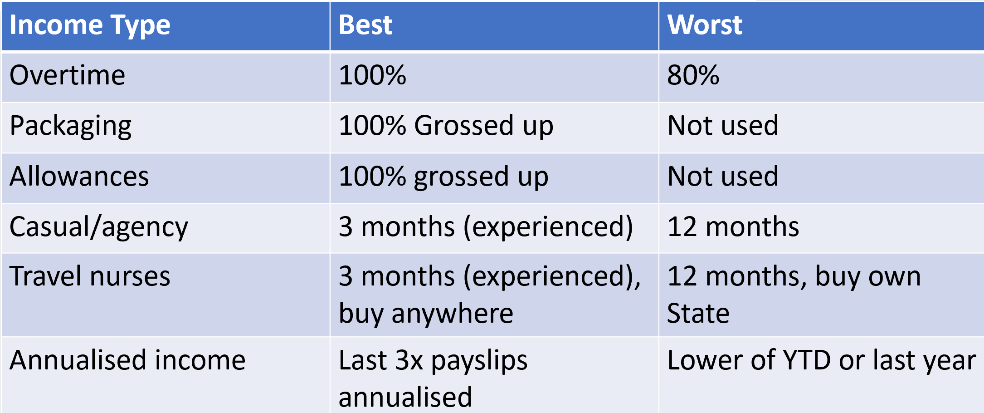
It is the other line items on your payslip that significantly impact your borrowing capacity: overtime, allowances, penalties, salary packaging, casual, and so on.
While these add to your total income, the key is how different lenders recognise and value them.
The unknown secret and opportunity for you is that lenders may assess these other income sources differently.
The differences can be surprising and certainly make a big difference to the size loan you can be approved for.
Here’s a table that highlights how different nurses’ income components might be considered by lenders when assessing borrowing capacity:
This makes a large difference.
Below, I have copied an example of the range from a public hospital RN and her partner, who have two dependents.
I have filtered out lenders with competitive interest rates and service.
Their borrowing capacity ranges from $619,029 down to $577,913, even with exactly the same inputs!
This gives them more than $40,000 advantage by selecting the right lender.
So, when answering the borrowing capacity question, it’s important to understand how different lenders assess your income and choose the one that best suits your situation.
This will change based on your specific income situation.
That is the opportunity.
However, unless you know each lenders policy and how to maximis0e for each situation, you’re essentially relying on luck to get it right.
Each nurse’s situation is unique, and finding the right lender requires personalised advice.
Don’t worry though, our expertise and lender software can help you maximise your borrowing capacity and secure the best possible deal.
Don’t let the ‘20% deposit’ myth hold you back! Many first-time homebuyers mistakenly believe they need a 20% down payment. But the truth is, it’s often not necessary.
Our experience shows it’s entirely possible: Over the past year, we’ve helped hundreds of clients purchase their first homes with deposits well below 20%.
In fact, only a handful had the full 20%. And even better, most avoided costly lender’s mortgage insurance (LMI).
How do we do it?
We leverage the Government Guarantee Schemes that offer 5% deposit options for some first-time homebuyers
Be aware, that not all banks participate in this scheme, so if you are dealing with your bank directly, be sure to ask them why they haven’t mentioned it.
Also, this scheme is not to be confused with the state based “equity” schemes, where the government co-owns your property. Tread carefully if considering these.
For the Government Guarantee Scheme, lender’s policies do differ, but some even allow this 5% to be gifted to you.
If you are an RN and don’t qualify for this scheme or aren’t a first-home buyer, some lenders offer options for registered nurses, paramedics, midwives, and others with only a 10% deposit. We do a lot of these.
There may be other options open to you such as parental guarantees or separate funding facilities, to bridge the gap.
We’re committed to finding a solution that works for you, so don’t let a large deposit hold you back.
You don’t need 20%!
Your credit history matters, but it’s not always as complicated as you might think.
Many times, new clients have said to me, they were told they need a credit card or car loan to build a credit history, but that’s often not the case.
You do not!
If you have a mobile phone or an electricity bill in your name, you likely already have a credit history.
A healthy credit score is built on two pillars: timely payments and responsible credit usage.
Avoid applying for excessive credit, especially ‘buy-now-pay-later’ and payday loans, as these can raise red flags for lenders.
While most lenders will scrutinise your credit history when considering large loans, it’s important to note that not all lenders treat credit transgressions equally.
While many lenders have minimum credit score requirements, it’s important to remember that not all are created equal.
Some lenders are more flexible and may consider your application even if you don’t meet the minimum credit score. Don’t worry if you’re concerned about your credit score. We’ve successfully helped many clients in similar situations.
Remember, a strong credit history can open doors to better financial opportunities. By following these guidelines, you’ll be well on your way to achieving your homeownership goals.